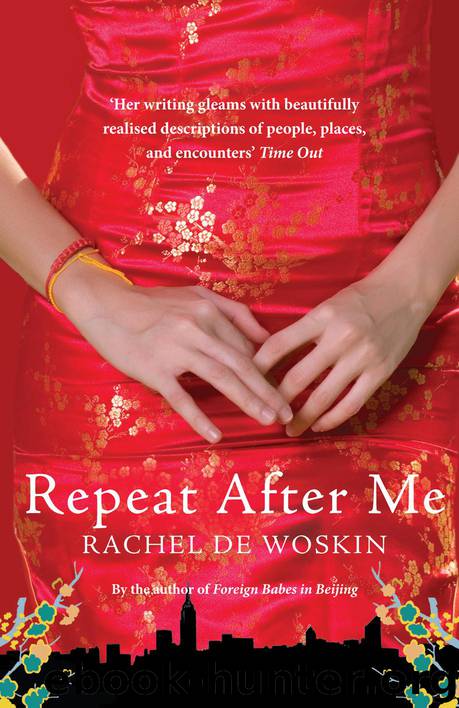
Repeat After Me by Rachel DeWoskin
Author:Rachel DeWoskin
Language: eng
Format: mobi, epub
Publisher: Gerald Duckworth & Co Ltd
Published: 2011-01-15T22:00:00+00:00
I look forward with an addict’s love to the mundane routine of my Sunday morning lessons with Teacher Hao: the tea jar he brings, the metal sound of its cap coming off for sips, the clean lines of Tang poems, his repetitive, unsuccessful explanations of why I’m syllabically and tonally off, the sunlight shifting outside my living-room windows, first imperceptibly and then so completely until the room and the pages of our poems appear to be on fire. We end at noon. This week we worked on a poem about drinking alone, one I love but that Teacher Hao insists I can’t possibly understand, what with my American nature. It’s a Li Bai poem, and Teacher Hao says it has a masculine bent. I’ve been ribbing him that Li Bai was in touch with his feminine side, in love with flowers and moonlight.
“Those are not feminine things,” Teacher Hao said.
“Really? The natural world isn’t, by most definitions, feminine?”
“Tang poets are men,” he said.
“But that’s because women weren’t encouraged to write, and their writings weren’t published, right? Like in the West.”
“Let’s look at this part again,” he said, ignoring me. He read in a lilting Beijing accent: “I lift my glass, invite / the bright moon, who casts back a shadow / Making us three. / But the moon can’t drink / and my shadow studies me carefully.”
He stopped there. “What do you make of it?” he asked.
Aware he might dislike it, I said, “I wish the moon could make us three.”
“That’s very American,” he said, meaning that if you make a poem about your daughter and her lost father, you’re focusing on yourself, thinking from the inside out.
“This is a poem about universality. About the condition of man, and the contradictions that provide balance in both the natural world and poetry: loneliness and companionship, dark and light, reality and shadow,” Teacher Hao said.
“Mom, let’s go!” Julia Too called from the hallway. I pushed my chair back.
“Coming,” I said.
“Where will you go today?” Teacher Hao asked, closing his books.
“Rock climbing,” I said.
He shook his head in disbelief, maybe at the risks we took, or maybe at the frivolous lives of Westerners here. In either case, I agreed.
“She loves it,” I said, shrugging guiltily. “And it’s good exercise.”
I thought of his look as Julia Too and I biked past by the U.S. Embassy. The line, always long, seemed especially infinite, twisting out the back of the silk market and around the block. After 9/11, they moved the line away from the embassy itself, and created a series of ropes to control the crowd. There are also now three different layers of security, even if you just stop by to add pages to your passport. Americans have always been able to enter the U.S. Embassy without waiting in line, which both makes sense and feels miserably unfair and awkward in front of the hundreds of students and grandparents lined up for visas—most of whom will be denied. As we approached the park, I
Download
This site does not store any files on its server. We only index and link to content provided by other sites. Please contact the content providers to delete copyright contents if any and email us, we'll remove relevant links or contents immediately.
Red by Erica Spindler(12543)
Crooked Kingdom: Book 2 (Six of Crows) by Bardugo Leigh(12283)
Twisted Palace by Erin Watt(11131)
Mindhunter: Inside the FBI's Elite Serial Crime Unit by John E. Douglas & Mark Olshaker(9282)
Fangirl by Rainbow Rowell(9208)
Never let me go by Kazuo Ishiguro(8834)
All the Light We Cannot See: A Novel by Anthony Doerr(8470)
A Man Called Ove: A Novel by Fredrik Backman(8413)
The Lover by Duras Marguerite(7872)
Confessions of an Ugly Stepsister by Gregory Maguire(7862)
Little Fires Everywhere by Celeste Ng(7165)
The Vegetarian by Han Kang(6269)
To All the Boys I've Loved Before by Jenny Han(5823)
The Shadow Of The Wind by Carlos Ruiz Zafón(5675)
On the Yard (New York Review Books Classics) by Braly Malcolm(5518)
Keepsake: True North #2 by Sarina Bowen(5405)
Dancing After Hours by Andre Dubus(5267)
Ken Follett - World without end by Ken Follett(4700)
The Perks of Being a Wallflower by Stephen Chbosky(4622)
